


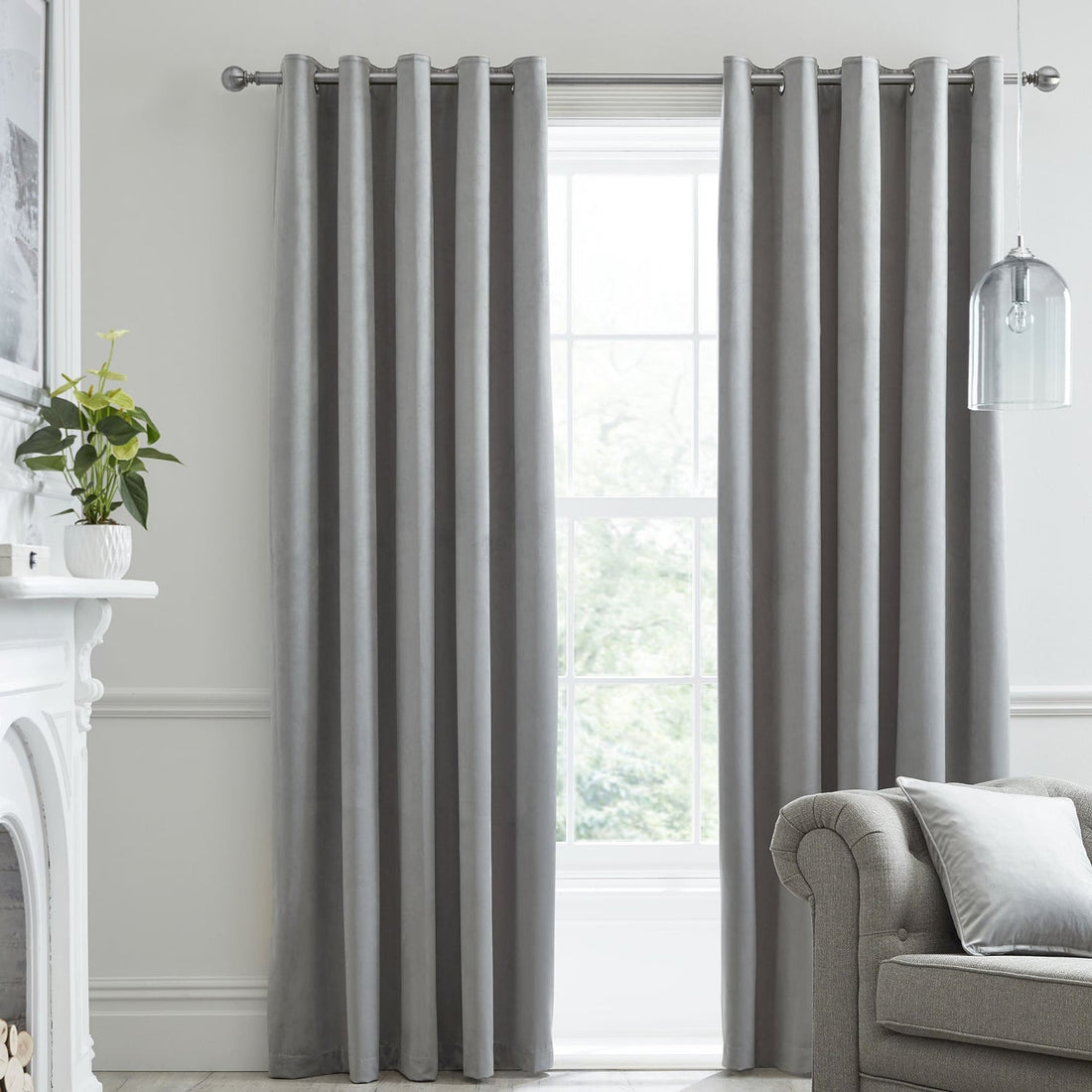
Laurence Llewelyn-Bowen Montrose Silver Velvet Blackout Eyelet Curt...
Why customers love this


Ready-made curtain details
Laurence Llewelyn-Bowen Montrose Velvet Blackout Eyelet Curtains in Silver Light Filtering details
Laurence Llewelyn-Bowen Montrose Velvet Blackout Eyelet Curtains - Silver Light Filtering are ready-made curtains in Silver, designed for a neat window finish with eyelet styling and blackout, polyester, velvet details.
Each pack is supplied as a pair. Material: 100% Polyester. Available sizes include 46" x 54", 46" x 72", 66" x 54", 66" x 72", 66" x 90", 90" x 72", 90" x 90". Colour shown: Silver.
- Heading: Eyelet.
- Pack contents: Sold as a pair.
- Lining and light control: Blackout, Light Filtering.
- Fabric content: 100% Polyester.
- Care: Professional dry cleaning only. Iron on low. Do not tumble dry.
For the Silver option, check the eyelet heading, the 7 available sizes, fabric content and care details before checkout. Range: Laurence Llewelyn-Bowen Montrose Velvet Blackout Eyelet Curtains.
Curtain questions before you buy?
Quick answers for ready-made curtain sizing, headings and pack contents.
What are the benefits of these curtains?
What material are they made from?
How are these curtains installed?
Curtain measuring guideHow to measure your window for curtainsSimple step-by-step help for measuring poles, tracks, width and drop.
For made-to-measure curtains, we need two measurements: the width of your fitted pole or track and the drop to your chosen finishing point. Follow the steps below and record every measurement in centimetres (cm).
Before you start
- Fit the pole or track first wherever possible. Its final position affects both measurements.
- Use a rigid metal tape measure, a pencil and a safe step ladder. Ask someone to help with wide windows.
- Measure every window separately, even if two windows look the same.
- Measure twice and write down the exact result in centimetres.
- This guide covers standard straight poles and tracks. For a bay, curve, sloping ceiling or unusual fitting, contact us before ordering.
Choose the row that matches your curtains
On a phone, swipe the table sideways to see every column.
| Heading | Hanging from | Width to measure | Where the drop starts |
|---|---|---|---|
| Eyelet | Curtain pole | Full pole width, excluding finials | Top of the pole |
| Pencil pleat | Track or pole with rings | Full track or pole width | Top of track, or bottom of the small eye on a pole ring |
| Pinch pleat | Track or pole with rings | Full track or pole width | Top of track, or bottom of the small eye on a pole ring |
Step 1: Measure the width
Measure the fitting your curtains will hang from—not the glass or window frame—unless you have not fitted a pole or track yet.
Curtain pole
Measure the usable pole from one end to the other. Do not include the finials, which are the decorative end pieces.

Straight curtain track
Measure the entire track from the far left end to the far right end.

Track with a centre overlap
First measure the full track width (A). Then measure the overlapping section in the centre (B). Add the two numbers together: order width = A + B.

No pole or track fitted yet?
For the most accurate result, fit it before measuring. If that is not possible, measure the window recess and add 30 cm in total—15 cm on each side. Check that there is enough clear wall space and no furniture, radiators or switches in the way.
Step 2: Choose the finish and measure the drop
The drop is the finished length from the correct starting point for your heading to the place where you want the curtain to end.
Common finishing points
On a phone, swipe the table sideways to see every column.
| Finish | A useful starting point | Best for |
|---|---|---|
| Sill length | Finish 0.5–1 cm above the sill | A neat finish that clears the sill |
| Below the sill | Finish about 15 cm below the sill | Extra coverage without going to the floor |
| Floor length | Finish 1–2 cm above the floor | A full-length curtain that should not drag |
These are practical starting points rather than strict rules. Choose the finish you want before taking the drop.
Eyelet curtains on a pole
Measure from the very top of the pole down to your chosen finishing point.

Pencil pleat or pinch pleat on a track
Measure from the top of the track down to your chosen finishing point.

Pencil pleat or pinch pleat on a pole with rings
Measure from the bottom of the small eye on the curtain ring—where the curtain hook sits—down to your chosen finishing point.

Check for an uneven sill or floor
Measure the drop at the left, centre and right. If the curtains should clear the sill or floor, use the shortest measurement so the hem does not drag.
Final check before ordering
- The pole or track is fitted in its final position wherever possible.
- The width is the full pole or track width—not the window width and not one curtain.
- Finials have been excluded from a pole measurement.
- The centre overlap has been added if your track has one.
- The drop starts from the correct point for your heading and fitting.
- Every measurement is written in centimetres and each window is labelled separately.
Measuring questions
Do I add extra width for curtain fullness?
No. Enter the actual width of your pole or track. We work out the fabric allowance and fullness for the pair.
Can I measure an old pair of curtains instead?
We recommend measuring the fitted pole or track and the required drop. Old curtains may have stretched, shrunk or been made for a different heading.
What if my pole or track is not fitted?
Fit it first if you can. If that is not possible, measure the window recess and add 30 cm in total—15 cm on each side—then check that the planned position is clear.
What should I do with a bay or curved track?
Do not measure straight across the bay. Measure along the complete path the track follows, including any bends and overlaps, and contact us before ordering if you are unsure.
Still unsure?
Made-to-measure orders depend on accurate measurements. Contact us before placing your order and we will help you check the correct method.
Honest customer feedback
Customer reviews
Loading customer reviews…
We publish genuine positive and negative reviews. We only remove content that is spam, abusive, contains personal information or is unrelated to the product.
Reviews moved from our previous review provider are shown with their original rating, wording, reviewer name and date.